
what are you looking for?

Whether you are an outdoor enthusiast looking to conquer rugged trails, a farmer needing a reliable workhorse, or an amusement park investor planning to build a profitable off-road rental fleet, you likely have many questions about ATVs.
From understanding basic terminology to navigating safety gear, speed limits, and commercial fleet shipping weights, the world of off-road vehicles can be complex. To help you make informed and profitable decisions, Carnee Rides, a leading Chinese ATV Quad Bike manufacturer with over 20 years of ATV production experience, has compiled this Ultimate ATV FAQ Guide.


ATV stands for All-Terrain Vehicle. Depending on where you are in the world, it is also widely known by several other names, including quad, quad bike, and 4-wheeler (or four-wheeler). By definition, an ATV is a motorized off-highway vehicle designed to travel on four low-pressure tires over unpaved surfaces. It features a straddle-style seat (similar to a motorcycle) and is steered using handlebars. Whether you call it an ATV, a quad bike, or a 4-wheeler, these machines are built to be nimble, rugged, and capable of navigating dirt, mud, sand, and rocky trails.
Standard ATVs are designed with a single “straddle-style” seat for one operator only. While some specialized “2-up” ATVs exist with a proper secondary seat and passenger footpegs, you should never carry a passenger on a standard single-seat ATV.
Most traditional ATVs run on standard unleaded gasoline. However, the industry is rapidly evolving. Electric ATVs (EVs) are becoming increasingly popular, especially for indoor arenas, eco-resorts, and nature parks where noise and exhaust emissions are strictly regulated. As a direct ATV manufacturer, we offer both high-performance gas engine ATVs and low-maintenance electric ATVs.
This is one of the most frequently asked questions by rental business investors trying to choose the right vehicles for their parks.


UTV stands for Utility Terrain Vehicle (or Utility Task Vehicle). Commonly referred to as a “side-by-side” (SxS), a UTV is a rugged off-road vehicle explicitly designed for work or recreation.
Unlike an ATV, where the rider straddles the machine, a UTV allows passengers to sit side-by-side, offering a much more comfortable experience. Here are its key defining features:
Because they excel at traversing difficult terrain like mud or rocky trails while carrying cargo and passengers, UTVs are highly favored for common applications such as ranching, hunting, trail riding, and construction work.
Engine sizes range from 50cc to 1000cc. Here is a general guide:
The top speed depends heavily on the engine size (CC) and rider weight:
They certainly can be if left unregulated. When you purchase wholesale from a professional manufacturer like Carnee Rides, you can request commercial ATVs equipped with adjustable Speed Governors. This allows operators to manually lock the maximum speed (e.g., 10 or 15 mph) based on the rider’s experience level. This smart feature guarantees full engine torque for climbing hills while ensuring safety compliance and drastically lowering your commercial liability insurance premiums.

Like any motorized powersport vehicle, ATVs carry inherent risks if driven recklessly. However, park owners can effectively minimize these risks by mandating proper safety gear (helmets and goggles) and providing a quick pre-ride briefing. Furthermore, investing in commercial-grade ATV quad bikes designed with a wider wheelbase and low center of gravity provides exceptional stability, naturally reducing the risk of tipping and keeping your guests safe on the trails.

Unlike motorcycles that lean smoothly into corners, most four-wheelers have a solid rear axle. This means the rear wheels cannot turn independently of one another. To turn effectively, the ATV needs to be under power (using the throttle), and the rider must shift their upper body weight into the turn to counteract centrifugal force.
Tire pressure and tread patterns are critical for your ATV’s traction, safety, and lifespan.

Commercial Tip: For rental fleet operators, ensuring your ATVs have the correct tire pressure and tread for your specific park terrain minimizes dangerous wheel spin, improves rider control, and drastically reduces your long-term ATV maintenance costs.
👉 Want to dive deeper into tire specs and maintenance? Read our complete guide: How to Choose the Right ATV Tires: Tread Patterns & Pressure Explained
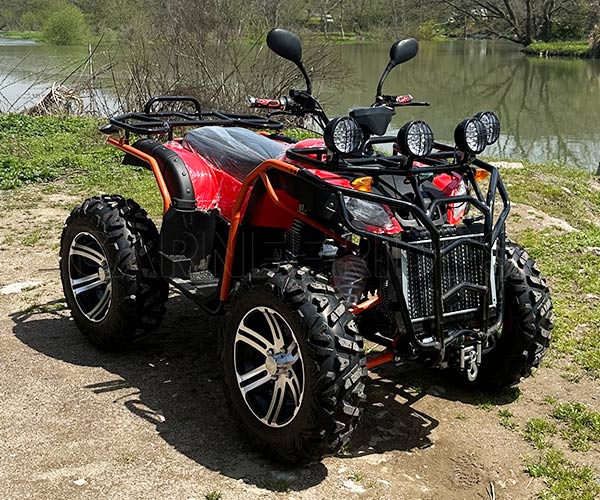
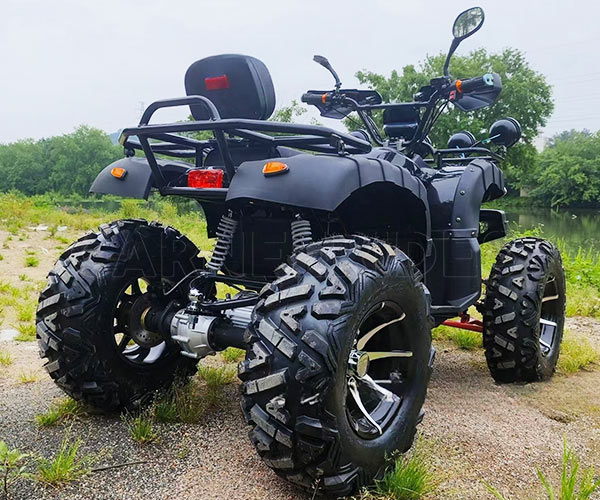
In most jurisdictions worldwide, ATVs are strictly designed for “Off-Highway” use and are not street legal on public roads or highways.
However, in certain rural farming communities or specialized tourist towns, ATVs may be allowed on local roads if they are modified with street-legal kits (turn signals, mirrors, horns) and properly registered. Always check your local municipal laws.
If you are riding strictly off-road on private land, farms, or a dedicated rental track, a standard driver’s license is generally not legally required by the state. However, if you intend to cross or ride on any public roads, a valid driver’s license is almost always mandatory.
The weight of an ATV varies significantly by its size and intended use:


Youth ATVs (50cc-110cc): Typically weigh between 150 and 250 lbs (68-113 kg).
Adult Utility ATVs (250cc-500cc): Generally weigh between 400 and 650 lbs (180-295 kg).
Commercial Tip: Knowing the exact dimensions and weight is crucial for B2B buyers calculating international shipping.
When you buy wholesale from us, our logistics team optimizes the packaging (using durable Iron Frames) to maximize the number of ATVs that fit into a 20ft or 40HQ shipping container, significantly lowering your freight cost per unit!


If you purchase a single, name-brand recreational ATV from a local retail dealership, prices typically range from $5,000 to well over $16,000. For an entrepreneur building a rental fleet or outfitting a farm, paying these retail prices will severely eat into your profit margins.
However, buying wholesale directly from a proven Chinese quad bike manufacturer like Carnee Rides is the smartest financial decision you can make. Because we cut out the middlemen, our factory-direct pricing offers an incredible range from $300 to $15,000.
This drastically lower initial investment, combined with the high daily revenue of ATV rentals, allows most commercial operators to achieve a full Return on Investment (ROI) in just 3 to 6 months.

Navigating the ATV market shouldn’t eat into your profit margins. As a premier Chinese source manufacturer with over 20 years of amusement and off-road vehicle experience, Carnee Rides is more than just a supplier—we are your long-term business partner.
Whether you are expanding a heavy-duty farm or launching a high-traffic ATV rental park, here is what we can provide for your business:
Unbeatable Factory-Direct Pricing:
From $300 entry-level youth ATVs to $16,000 premium commercial UTVs, we cut out the middlemen to maximize your ROI.
OEM/ODM Customization
Need specific body colors, custom park logos, or adjustable speed governors? Our factory can customize your fleet to match your brand and safety requirements perfectly.
Global Shipping & Smart Packaging
Our logistics team utilizes highly durable Iron Frame packing (CBU/SKD) to maximize container space and significantly lower your international sea freight costs.
Lifetime After-Sales & Spare Parts
We keep your fleet running. We provide 24/7 technical support and supply wear-and-tear parts (tires, brake pads, spark plugs) at factory-cost prices for life.
[Contact Us for a Free ATV Wholesale Quote & Factory Catalog] today to see how we can help you achieve a 3-to-6-month ROI!

Whatsapp : +86 13623710276
Email : [email protected]
Address : High-tech Industrial Development Zone, Zhengzhou


