
what are you looking for?


When planning the transportation and attraction layout for a new amusement park, shopping mall, or scenic resort, operators face a critical decision between installing a track train system with fixed steel rails or choosing a flexible trackless train system. Making the wrong choice can lead to excessive installation costs, inefficient crowd management, or underutilized venue space.
Industry Insight: Based on our experience supplying amusement equipment worldwide, among the 1,000+ clients we have served, 70% ultimately choose trackless trains for their versatility and low barrier to entry. The remaining 30% who invest in track trains usually operate large outdoor venues that require high passenger throughput and a permanent landmark presence.
This is not just a technical comparison—it’s a comprehensive, data-driven guide for park operators to evaluate ROI, licensing requirements, and hard installation costs. Whether you are seeking an amusement train ride or a specific kids train ride, this guide will help you make the most profitable choice.
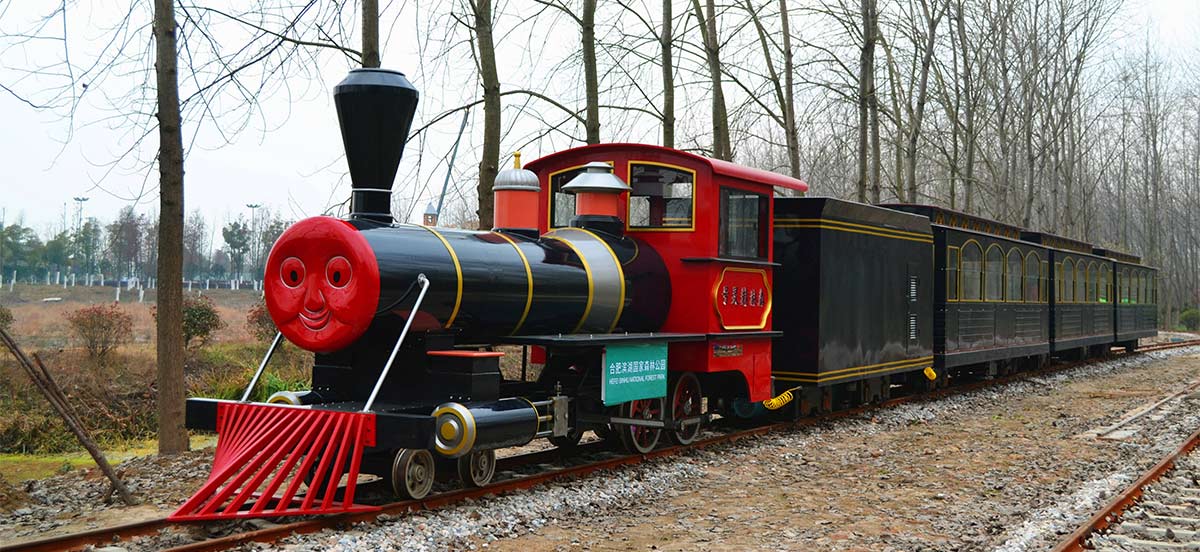
A track train ride (often referred to as a traditional train or scenic park train) is a classic amusement ride that operates strictly on pre-installed steel rails.


A trackless train ride operates entirely without steel rails, utilizing rubber pneumatic tires and an automotive-style steering system. It drives on regular flat surfaces, dramatically lowering overall investment costs.

To help you navigate the market, here is a deep dive into the real-world financial differences between the two systems.
Trackless Train Costs: The barrier to entry is extremely low. Industry benchmarks show that a small 1-locomotive, 3-carriage model (19 seats) can start as low as $5,500. Large-capacity models (1-locomotive, 2-carriages for 42 to 71 seats) range from $45,000 to $70,000. Even if you need to pave a dedicated 5km concrete path, road paving is a generic park upgrade, not an exclusive train cost.
Track Train Costs: Laying tracks is a massive civil engineering project. Standard comprehensive costs range from $210,000 to $310,000 per kilometer (approx. 1.5M – 2.2M RMB). If your route involves complex geography—like bridges, tunnels, or soft soil—the cost can skyrocket to $280,000 – $700,000+ per kilometer.
(See more: Buying Amusement Track Trains: 8 Costly Traps to Avoid)
Theme Park Track Trains: High long-term value, but track maintenance (alignment, rust prevention) requires continuous funding.
Tourist Trackless Trains: Zero track maintenance. Operational costs are limited to standard vehicle upkeep, electricity/diesel, and periodic battery/tire replacements.
The biggest difference lies in the speed and scale of cost recovery. Here is how real parks have monetized both systems:
Trackless Train ROI (Rapid Cost Recovery): Due to low initial costs, a small trackless train running 15 to 20 trips a day in a high-traffic scenic area can recover its entire vehicle investment in just 15 to 20 days (or within one month during slower seasons).
Track Train ROI (High-Volume Secondary Consumption):
Despite the high capital expenditure, amusement park track train rides are revenue beasts when combined with park ticket strategies. Here is how international venues monetize them:
Mid-Sized Family Park (South Asia): Invested approx. $115,000 for a 0.5km track and two 18-seat trains. With a $3 individual ticket price and nearly 500,000 annual visitors, the initial investment was fully recovered rapidly within the first season.
Scenic Luge Theme Park (South Korea): Invested approx. $285,000 for a 1.7km track (600mm gauge). Driven by explosive holiday tourist traffic and stunning scenic routes, the entire train investment was recovered in an astonishing 1 to 2 months.
Large Safari & Eco-Park (Middle East): A mega-project with a total infrastructure investment of $1.4 Million. Driven by consistent daily foot traffic and high secondary consumption, the ROI was completely realized in just 2 years, leaving decades of pure profit ahead for the park operators.

For quick comparison, here’s a technical snapshot of track vs. trackless train rides:
| Feature | Track Train | Trackless Train |
|---|---|---|
| Power System | 48V (transformed from 220V), high torque for steep or long routes | 72V battery system, quiet and efficient for indoor/outdoor use |
| Maximum Passenger Capacity | 40–70+ passengers | 12–40 passengers |
| Gradeability / Incline | Moderate inclines only | 4%–10% depending on model and wheel design |
| Noise Level | Moderate | Low (<65 dB), ideal for malls and quiet zones |
| Surface Suitability | Fixed rails on even terrain | Asphalt, concrete, grass, gravel, indoor floors |
| Installation Complexity | High – track laying, civil engineering | Low – place train and run |

Choose a Trackless Train amusement ride if:
Venue: Shopping malls, indoor FECs, and pop-up carnivals.
Budget: Limited initial Capex.
Operational Need: Quiet (<65 dB) indoor operation and highly flexible routes.
Project Type: Temporary installations or seasonal holiday events.
Choose a Track Train amusement ride If:
Venue: Large-scale theme parks, forests, and waterfront scenic spots.
Goal: Immersive storytelling and massive passenger throughput.
Investment: Able to manage high initial Capex for long-term, high-volume Opex returns.
Project Type: Long-term route stability and fixed scenic loops required.

Carnee Rides has over 20 years of experience producing and installing premium amusement rides worldwide. When you partner with us, we offer trackless trains for sale and track trains for sale, delivering high-quality, customizable solutions for parks, malls, and resorts.
Premium Materials: Heavy-duty Q235 steel frames and durable, custom-painted fiberglass exteriors.
Global Certifications: Fully compliant with CE, ASTM, ISO, and SGS international safety standards.
Customizable Designs: Carriages, thematic styling, and track routes tailored specifically to your venue’s aesthetic.
Anti-Rollover Design: A precisely engineered low center of gravity (height ≤ 1.2 meters) to ensure ultimate passenger safety during turns.
Emergency Braking Systems: Certified stopping distances (≤ 5 meters) to protect pedestrians in crowded mall or park environments.
Turnkey Amusement Trains Services: Comprehensive support from initial concept design and production to site installation and lifelong after-sales service.
Ready to upgrade your park’s transportation? Contact us today for a free 3D venue assessment and a personalized quote tailored to your business goals.

A trackless train is a rubber-tired vehicle that operates without rails, ideal for amusement parks, malls, and resorts. It can run on concrete, asphalt, grass, or indoor floors. Trackless trains are flexible, quick to deploy, and perfect for temporary or seasonal routes, reducing installation costs.
For malls or indoor venues, a trackless train is usually the better choice. Its rubber tires allow smooth operation on indoor flooring, it generates low noise (<65dB), and can navigate tight corners. Trackless trains are cost-effective and easier to maintain in confined or temporary spaces.
Trackless train prices vary by size, capacity, and customization. Small indoor models for 12–20 passengers can cost $4,000–$10,000, while large outdoor trains for 40+ passengers range from $30,000 to over $50,000. Themed designs or battery upgrades increase the price.
The first trackless trains emerged in the mid-20th century for tourist and indoor attractions. They were battery-powered, low-speed vehicles designed to provide scenic rides without laying rails, evolving into today’s electric kids’ trains and sightseeing trains widely used in amusement parks.
A fully charged commercial trackless train can typically operate continuously for 8 to 10 hours, easily covering a standard business day. The heavy-duty batteries themselves usually require replacement every 2 to 3 years. To maximize your ROI and extend their lifespan, we highly recommend following a strict trackless train battery maintenance routine.

Whatsapp : +86 13623710276
Email : [email protected]
Address : High-tech Industrial Development Zone, Zhengzhou


WhatsApp us

