
what are you looking for?

Last summer, we consulted with a commercial ATV rental operator in Louisiana who was losing thousands of dollars in weekend revenue. The problem wasn’t his machines; it was his rubber. He was running standard all-terrain tires in a swampy park that demanded aggressive mud treads. That one wrong tire choice resulted in stuck vehicles, snapped winch cables, frustrated tourists, and skyrocketing maintenance downtime.
ATV tire tread patterns and tire pressure (PSI) are the single biggest factors determining whether your quad grips, floats, or gets stuck. Whether you are an off-road enthusiast, a farmer, or a commercial fleet manager, most riders never give their tires a second thought until they are already axle-deep in trouble.
At Carnee Rides, a premier Chinese ATV manufacturer with over 20 years of experience building commercial-grade quad bikes, we engineer our machines from the ground up. In this ultimate 2026 guide, we break down the physics of every major tread pattern, the critical science of tire pressure, and give you a practical framework for matching rubber to terrain.
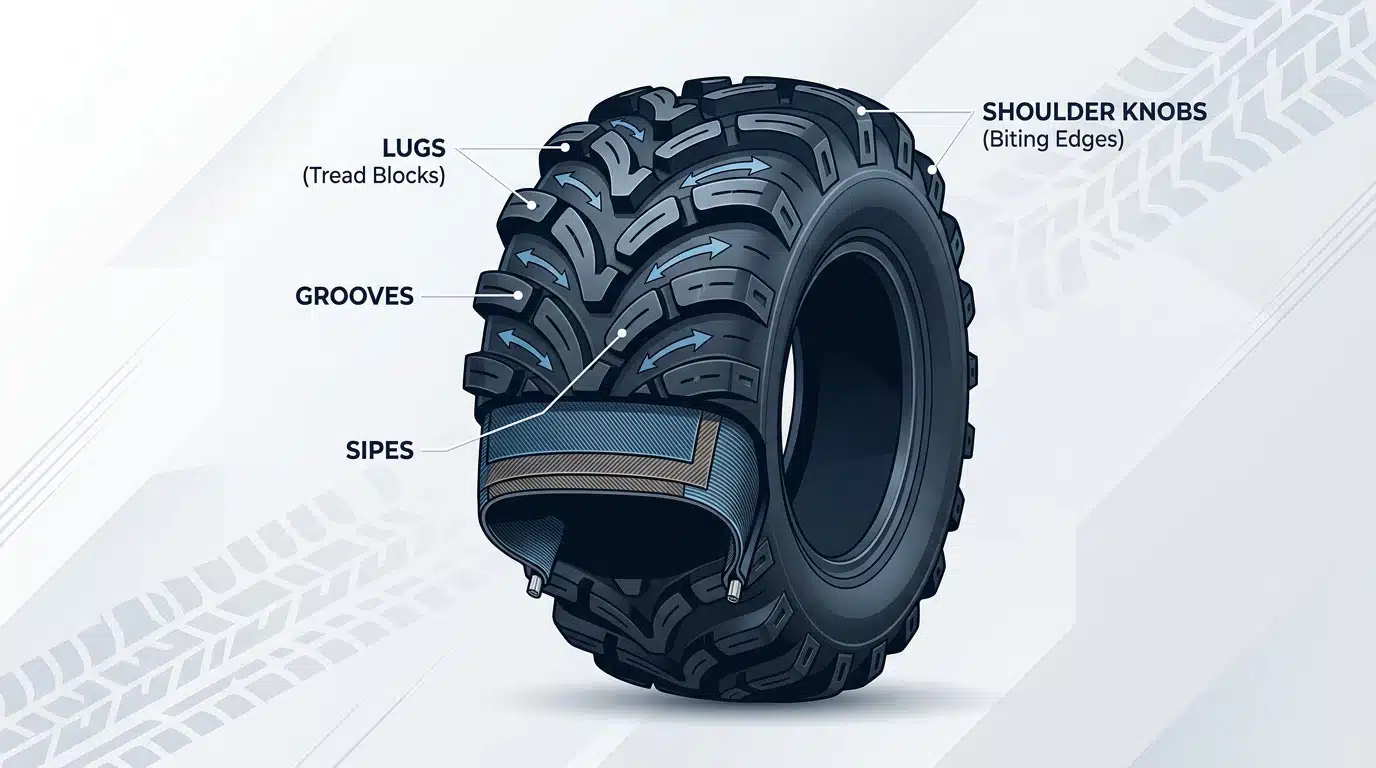
An ATV tire tread pattern is the arrangement of grooves, lugs, channels, and sipes molded into the rubber surface. Think of it as the tire’s fingerprint. But tread is only half the equation; tire pressure (measured in PSI) dictates how that fingerprint interacts with the ground.
Here is the engineering reality: your engine can produce 80 horsepower, but if your tread pattern and PSI can’t translate that power into forward motion on a specific surface, you’re going nowhere. We consistently see 400cc ATVs with the right mud treads outperform 700cc quads wearing the wrong rubber.
Tread patterns and pressure affect four critical performance areas:
Traction (Forward Grip): Deep, aggressive lugs bite into soft terrain. Lowering tire pressure flattens the tire, increasing the “contact patch” to put more of those lugs on the ground.
Handling: How predictably the ATV responds to steering inputs. The wrong tread or incorrectly high PSI on a hard surface creates unpredictable slip angles that can throw you off.
Stability & Liability: Side-to-side grip matters. For rental fleet operators, running aggressive mud tires at low PSI on paved trails dramatically increases the risk of rollover accidents and insurance claims.
Self-Cleaning Ability: A mud tire that can’t shed packed clay between the lugs becomes a slick tire within 50 feet. Wide void channels clear debris automatically as the wheel spins.
According to engineering resources, tread voids (the gaps between lugs) account for roughly 60% of a tire’s wet and soft-terrain performance. Get this wrong on your quad, and no amount of throttle control will save you.
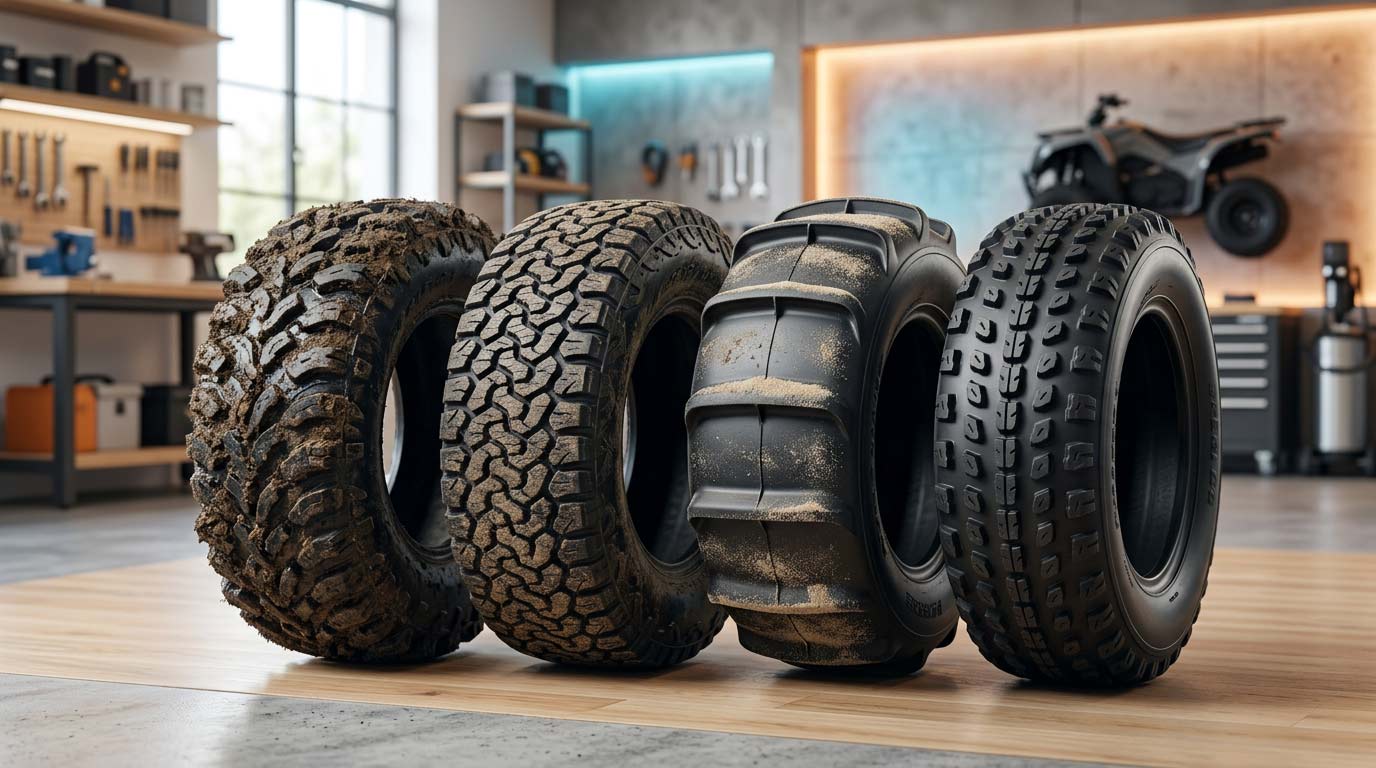
After decades of manufacturing, testing, and outfitting global fleets, we’ve found that every tread pattern traces back to four fundamental categories. You can’t cheat physics by picking one tire for everything.
| Tread Type | Lug Depth | Spacing / Voids | Best Terrain | Worst Terrain |
| Mud | Deep (1″–1.5″+) | Wide | Soft mud, swamps, wet clay | Pavement, hard-pack |
| All-Terrain | Medium (0.5″–1″) | Moderate | Mixed trails, gravel, light mud | Deep mud, loose sand |
| Sand | Paddle / Ribbed | Varies | Dunes, loose sand, beaches | Rocky trails, pavement |
| Hard-Pack / Racing | Shallow (0.25″–0.5″) | Tight | Groomed tracks, hard dirt, flat | Mud, sand, loose gravel |
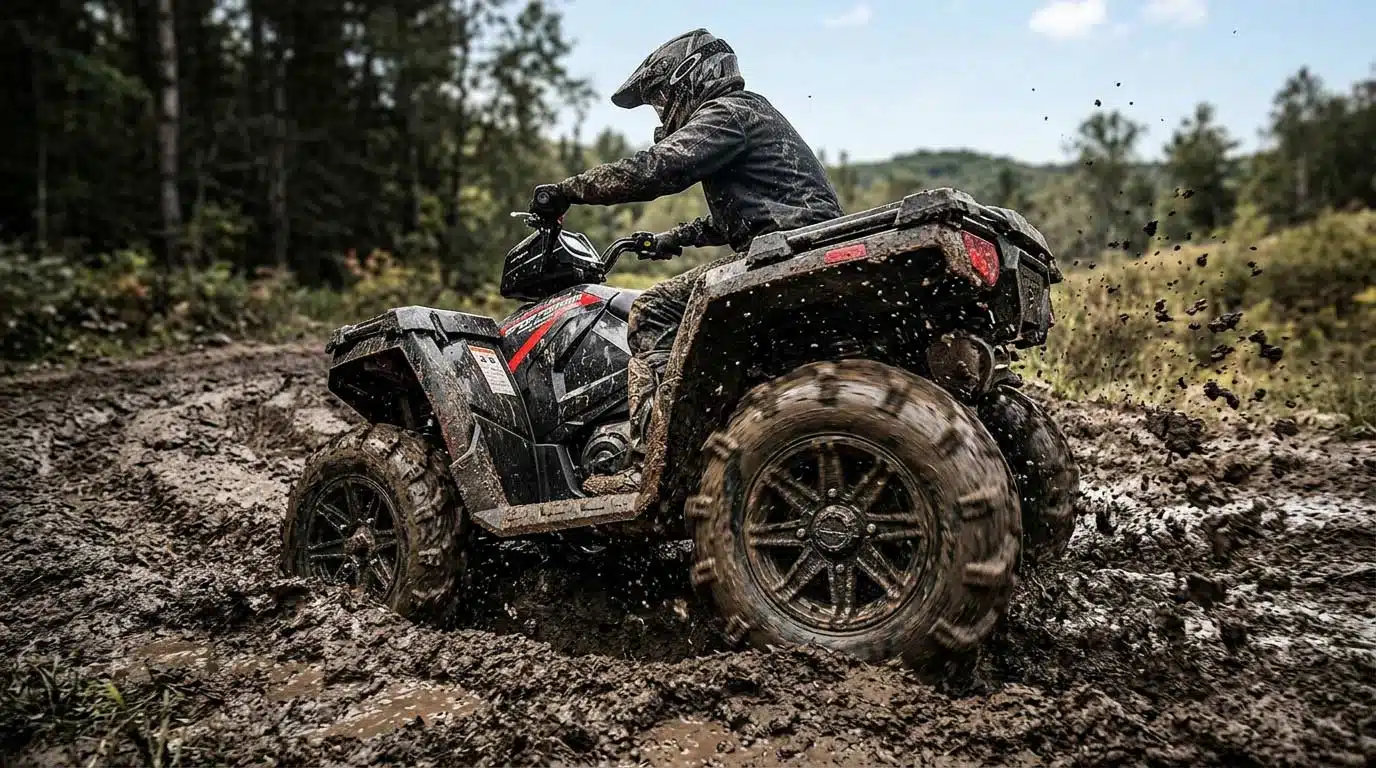
These tires are unmistakable—tall, aggressive lugs with wide gaps between them, designed to claw through saturated terrain.
The Physics: Deep lugs dig past the slippery surface layer, while the wide spacing allows centrifugal force to eject packed mud.
B2B / Fleet Warning: Do not buy mud tires for trails that are only muddy 20% of the time. On a gravel road or pavement, these tires cause severe vibration, wander unpredictably, and increase fuel consumption by up to 30%.
The Swiss Army knife of the ATV world. They feature moderate lugs spaced closely enough to provide decent contact area on hard surfaces, but with enough void to handle light mud.
The Engineering: The best all-terrain tires in 2026 feature micro-sipes (tiny slits) cut into the lug faces. These flex open under load to grip loose material without sacrificing lug strength.
Fleet Advantage: Because the lugs are shorter and support each other, they generate less heat. We regularly see clients get 3,000+ miles out of quality 6-ply all-terrain tires on mixed commercial trails.

In mud, you want to cut through the surface. In sand, there is no firm layer underneath, so tires must float and push.
Rear Paddles: Feature large, scoop-shaped fins that propel the ATV forward through displacement.
Front Ribs: Feature continuous circumferential ribs that resist diving into the sand, maintaining steering control.
Note: These 2-ply tires are dune-only equipment. Running them on pavement will destroy them instantly.
Where mud treads are tall and aggressive, racing treads are low, dense, and almost flat. On a hard, groomed surface, you need maximum rubber-to-ground contact.
The Advantage: Tightly spaced, short knobs translate directly to higher cornering speeds and drastically shorter braking distances (20–30% shorter than all-terrains on hard surfaces). Take them into the mud, however, and they become ice skates.
This is one of the most misunderstood topics in the industry, and a critical factor for commercial maintenance budgets.
Directional Treads: Have a V-shaped or arrow-like pattern that points in a specific direction of rotation. This design channels water and mud outward from the center (like a boat hull). The Catch: You cannot easily rotate them from the left side of the ATV to the right without remounting the tire on the wheel.
Non-Directional Treads: Have a symmetrical pattern that works equally well regardless of rotation. You can mount them on any corner of the ATV.
The Commercial Strategy: For extreme mud, Directional is required. But for utility work and mixed-trail rental fleets, Non-Directional is the champion. It allows fleet managers to execute easy tire rotation strategies, evening out tread wear and significantly lowering long-term replacement costs.
(Pro Tip: Never mount a directional tire backward! A backward V-tread actually funnels mud inward toward the center of the tire, ruining traction.)
While choosing the right tread pattern is critical, it is tire pressure (measured in PSI – Pounds per Square Inch) that activates that tread’s full potential. At Carnee Rides, our engineers emphasize that running the wrong PSI is the #1 cause of poor handling, premature tire wear, and rollover accidents in commercial fleets.
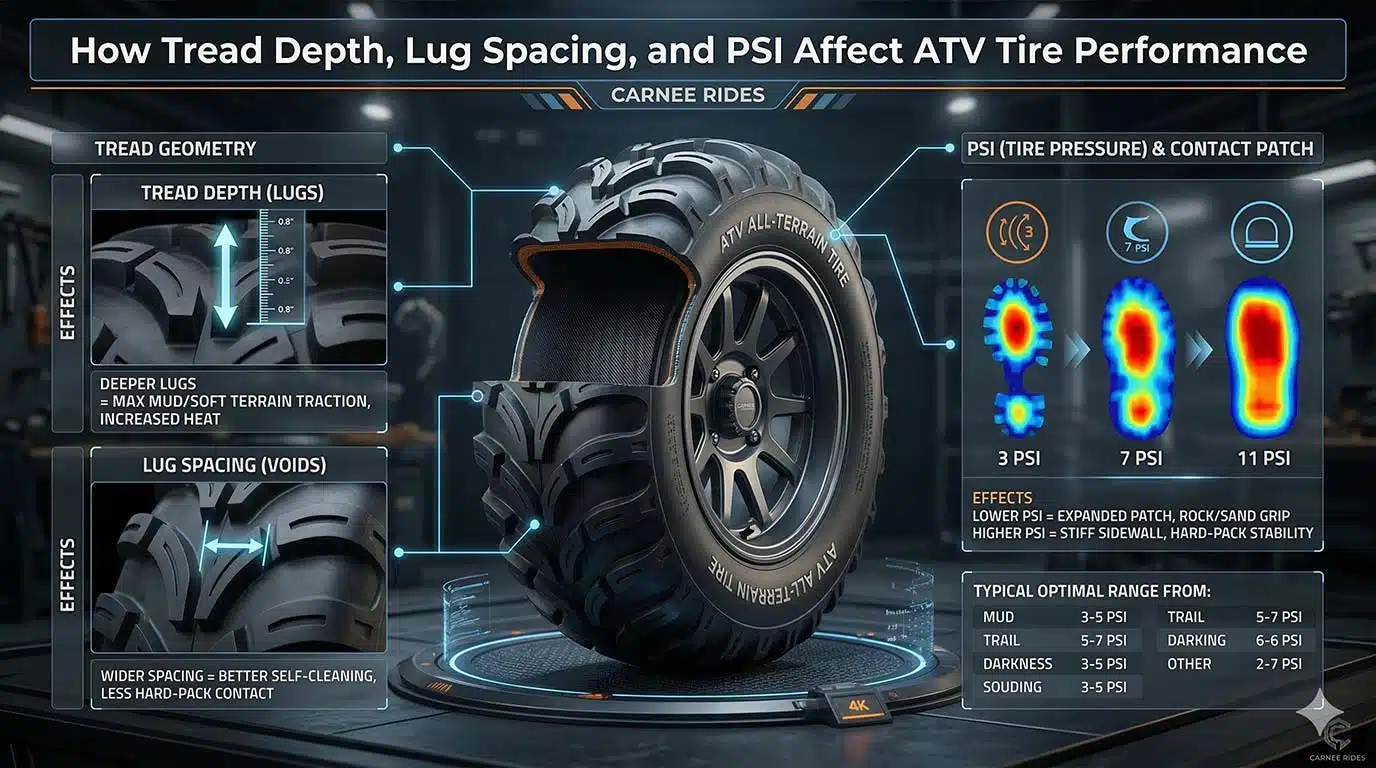
Unlike car tires that run at 30-40 PSI, most ATV tires are designed to operate at extremely low pressures—typically between 2 to 10 PSI. This low-pressure environment creates a dynamic “contact patch” that changes drastically with just a 1 or 2 PSI adjustment.
Here is the factory guide to dialing in your ATV tire pressure for maximum ROI and safety:
How it Works: Dropping the pressure allows the tire to physically flatten and deform over obstacles like rocks, tree roots, and soft mud. This maximizes the contact patch, allowing deep lugs to claw into the earth for ultimate forward traction.
Best Used For: Deep mud bogs, loose sand dunes, and slow technical rock crawling.
The Commercial Danger: If a rental guest drives a 3 PSI mud tire onto a hard dirt road or paved surface, the tire will flex violently on its sidewall during a turn. This creates a terrifying “wobbly” feeling and drastically increases the risk of the tire unseating from the bead (popping off the rim) or causing the ATV to roll over.
How it Works: This is the sweet spot for 6-ply all-terrain tires. It provides enough rigidity in the sidewall to handle higher speeds and cornering stability on hard-pack trails, while still offering enough flex to absorb bumps and grip moderate mud.
Best Used For: General trail riding, mixed-terrain rental parks, and light utility farm work.
Fleet Advantage: Maintaining a strict 5-7 PSI across your commercial fleet ensures predictable steering response for beginner riders and promotes the most even tread wear over the tire’s lifespan.
How it Works: Pumping the tire to its maximum recommended operating pressure creates a stiff, rounded profile. The contact patch shrinks, which reduces rolling resistance and allows for razor-sharp steering inputs.
Best Used For: Groomed racing tracks, paved road crossings, or when towing heavy loads (like agricultural sprayers or feed trailers).
The Trade-off: A 10 PSI tire hitting a rock will transfer the impact directly to the suspension and the rider’s spine. It sacrifices comfort and soft-terrain grip for heavy-duty load capacity and high-speed stability.
💡 Carnee Rides Pro Maintenance Tip: Because ATVs hold such a small volume of air, changes in ambient temperature will wildly swing your PSI. A tire set to 5 PSI in a warm garage can easily drop to 3 PSI on a freezing trail. For commercial operators, we highly recommend investing in low-pressure dial gauges (0-15 PSI range) and making weekly cold-tire pressure checks a mandatory part of your ATV maintenance routine.
Here is the factory cheat sheet for matching rubber to reality, applying the 80/20 Rule: Choose your tread pattern for the terrain you ride 80% of the time, and accept reduced performance in the other 20%.
Wooded trails with roots and rocks: All-terrain (0.75″–1″ depth). Avoid tall mud lugs, which catch on roots and make the ride brutally harsh.
Deep mud and swamps: Dedicated directional mud tread (1.25″+ depth) run at low tire pressure (3-5 PSI).
Rocky terrain: All-terrain or hard-pack tread with reinforced sidewalls (6-ply or 8-ply). You want shorter, stiffer lugs that won’t fold over under load.
Sand dunes: Paddle rears, ribbed fronts (2-4 PSI). No other combination works.
Snow and ice: Surprisingly, aggressive all-terrain tires with deep siping often outperform mud tires, which tend to pack with snow.
Pavement and hard surfaces (Farm/Ranch): Hard-pack or smooth all-terrain treads at higher pressures (7-10 PSI).
Pattern shape gets the attention, but the real performance story lives in the geometry.
Tread Depth vs. Heat: Deeper isn’t always better. Tall lugs flex more under lateral loads, causing unpredictable cornering. They also generate significantly more heat. We’ve measured surface temperatures 15-20°F higher on deep mud tires versus all-terrain tires at the same speed on hard-pack. Heat accelerates rubber degradation.
Lug Edge Geometry: A lug with a sharp, squared-off leading edge bites aggressively. A ramped or beveled leading edge transitions smoothly, reducing the “grabby” feeling on hard surfaces. Premium manufacturers engineer this edge geometry carefully.
Two riders on the same trail can have completely different tire needs. Let’s map it out:
Prioritize low rotational weight (accelerates faster), stiff sidewalls (less deflection in cornering), and heat-resistant compounds. A 4-ply sport tire on a racing quad isn’t a cost-cutting measure—it’s deliberate weight savings.
Durability and load capacity are king. We almost always equip utility fleets with heavy-duty 6-ply or 8-ply all-terrain tires. The tread should be moderately aggressive—enough to cross a muddy field, but not so aggressive that it tears up the lawn or makes the ATV sag when towing a heavy trailer.
This is the largest group. A quality 6-ply all-terrain tire handles 90% of mixed trail riding beautifully. The exception is if your local trails have a dominant characteristic (e.g., Southeast US swamps vs. Arizona deserts).
As an OEM manufacturer, we test the latest innovations. Here is what is real, and what is hype:
Hybrid Compound Treads (Real): Tires featuring a harder compound in the center (for durability and low rolling resistance) and a softer, stickier compound on the shoulder lugs (for cornering grip). This motorcycle-tech crossover is game-changing.
3D-Siping Technology (Real): Interlocking three-dimensional shapes within the sipe that lock together under heavy braking loads to prevent excessive lug flex, while opening normally for wet traction.
“AI-Designed” Patterns (Marketing Hype): Computational modeling has always been used. Calling it “AI” doesn’t change the physics. Judge a tire by its compound and geometry, not the press release.
“Self-Healing” ATV Tires (Hype): While common in cars, the ATV versions we’ve tested still struggle with anything larger than a small thorn. Don’t rely on self-healing tech as a substitute for a proper 6-ply carcass.
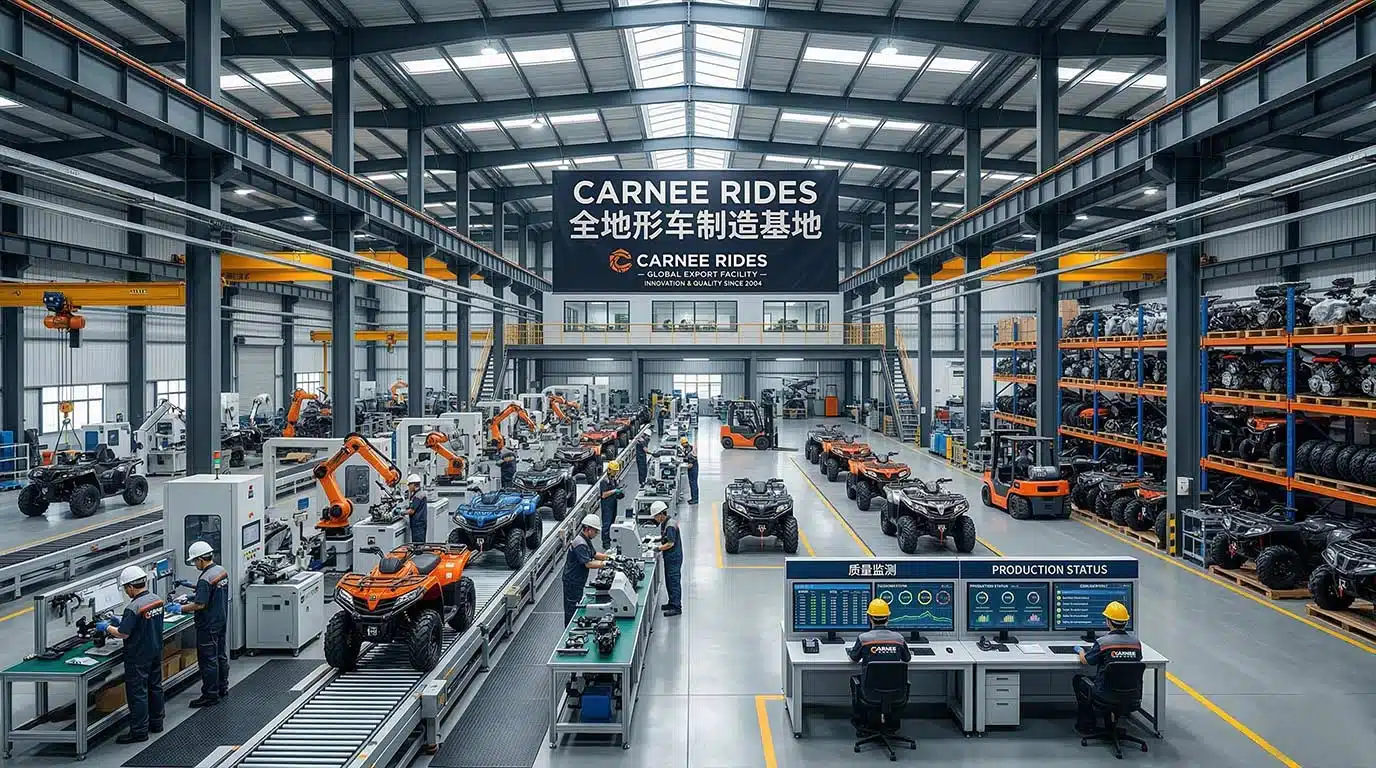
Tires are part of a bigger picture. If you are in the market for an ATV in 2026, the factory tire setup tells you exactly what the manufacturer intended that machine to do.
Check the Stock Tires First: A utility quad with aggressive all-terrain rubber is designed for mixed-condition work. If the stock tires don’t match your intended use, factor a $400–$700 tire swap into your budget.
Understand Ply Ratings: A 6-ply tire is stiffer than a 4-ply, handles cargo better, and resists rock punctures. However, it rides harder and weighs more. 6-ply is the sweet spot for most trail and utility riding.
Consider Direct-from-Manufacturer Value: The days of dismissing Chinese-manufactured ATVs are over. Companies like Carnee Rides hold strict ISO certifications and produce machines that compete on global quality standards. Buying factory-direct allows you to request pre-installed tire upgrades matched to your specific terrain, saving you massive aftermarket costs.
Technically yes, but it’s a terrible idea. The soft compound and tall lugs wear down rapidly on pavement, generate excessive noise, and drastically increase your braking distance.
For most riding, matching front and rear patterns works perfectly. The major exception is sand (paddles rear, ribs front). Running drastically different treads on hard surfaces can create dangerous handling imbalances.
Wear rate depends on terrain, PSI, and load. Most manufacturers recommend replacement when tread depth drops below 2/32 of an inch (1.6mm). However, performance degrades long before that. Inspect for dry rot, sidewall cracking, and loss of grip. Most commercial/recreational riders get 1,500-4,000 miles from a quality all-terrain set.
If you are outfitting a rental park, agricultural fleet, or off-road resort, buying retail ATVs and replacing the tires yourself destroys your profit margins.
By partnering with a source manufacturer like Carnee Rides, you get OEM Customization. Tell us your terrain, and our engineers will equip your wholesale fleet with the exact tread patterns, ply ratings, and speed governors you need directly from the factory line—maximizing your safety and your ROI.

Whatsapp : +86 13623710276
Email : [email protected]
Address : High-tech Industrial Development Zone, Zhengzhou


WhatsApp us

