
what are you looking for?


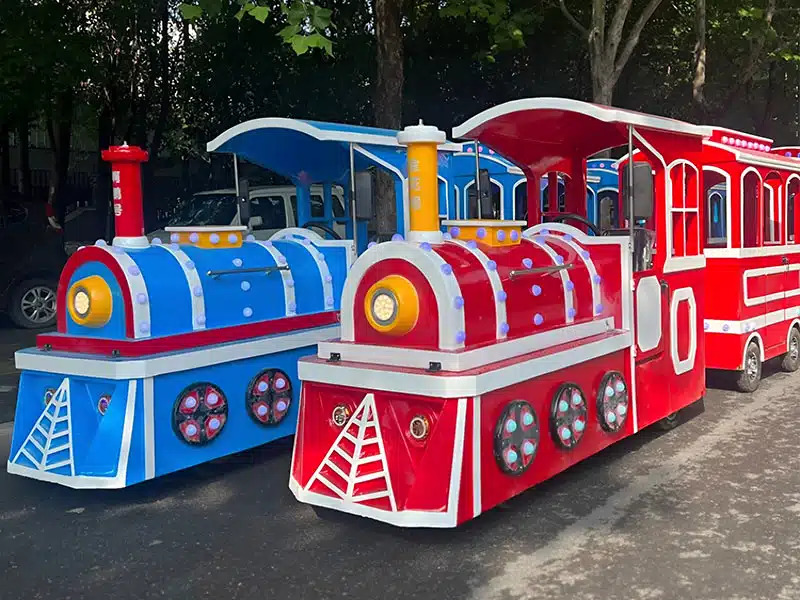
A trackless train works more like a road-going passenger vehicle than a railway train. A powered locomotive runs on rubber tires and pulls one or more passenger carriages through mechanical couplings. The driver controls the locomotive’s direction, speed and braking, while the carriages follow behind as the train moves through bends and straight sections.
On an electric model, the basic power flow is:
Battery → Controller → Electric Motor → Drivetrain → Drive Wheels
A diesel trackless train follows the same overall principle, except that an engine and transmission provide the driving force instead of batteries and an electric motor.
Because the vehicle travels on tires rather than steel rails, it does not need a permanently installed railway line. That is why the same basic vehicle may also be described as a tourist road train, sightseeing train, amusement park train, theme park train or mall train, depending on where it is used.
Technical note: Speed, turning radius, slope capability and passenger capacity vary significantly by model. The Carnee figures used below are examples from current product specifications rather than universal limits for every trackless train.
A trackless train is a passenger-carrying vehicle designed to resemble a small train while operating on suitable paved or firm surfaces without fixed rails.
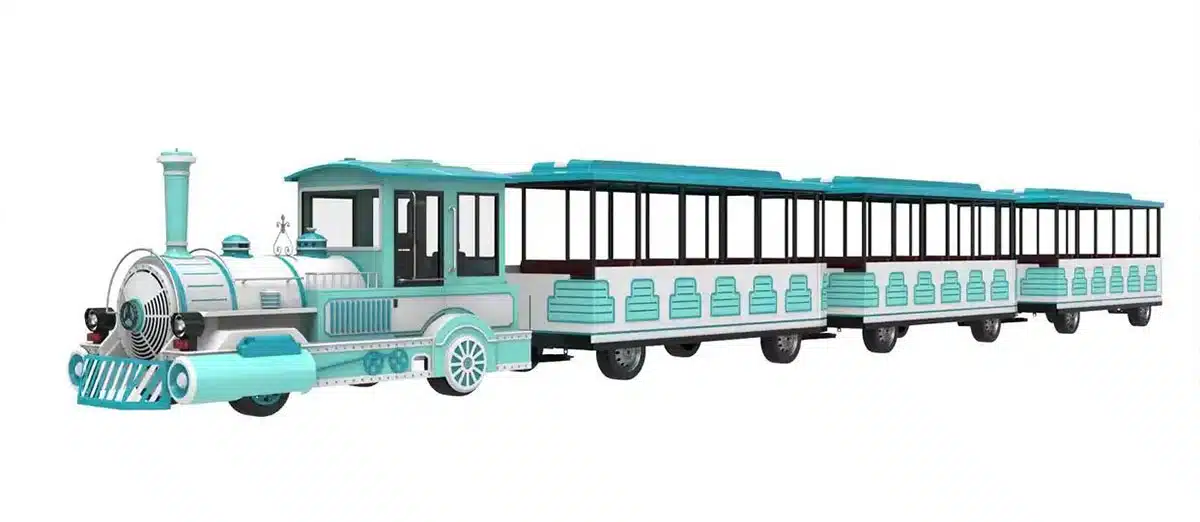
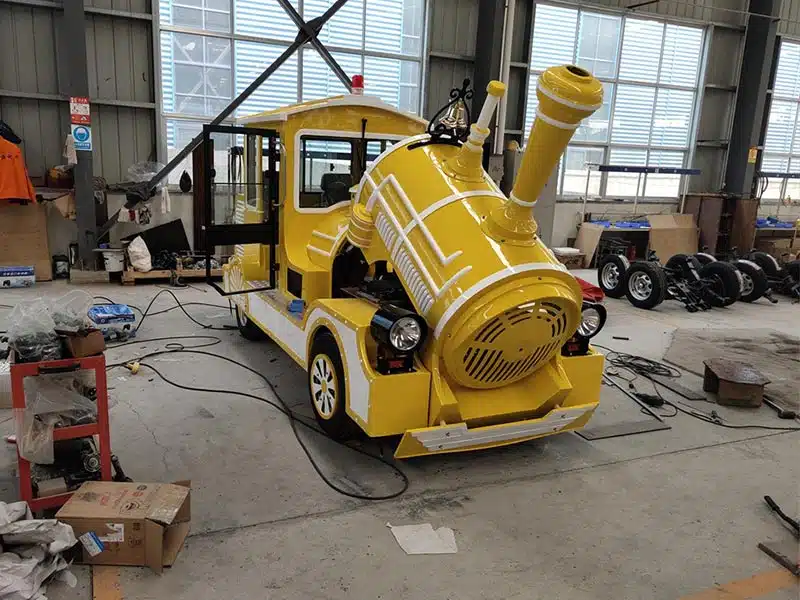
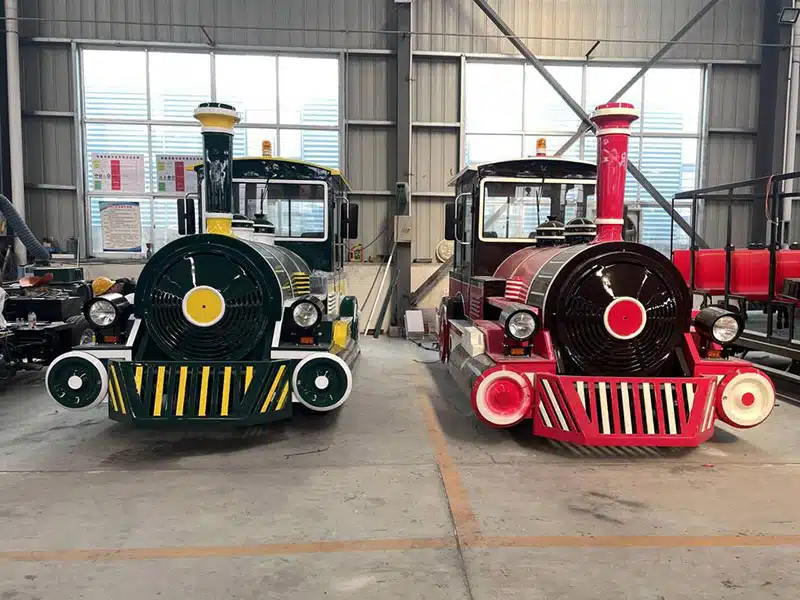
The front locomotive contains the main powertrain and driver controls. Passenger carriages are mechanically connected behind it and are pulled along the route.
This is the main difference from a conventional rail train: a rail vehicle is guided by the track, while a trackless train is steered like a road vehicle.
For a more detailed comparison of the two systems, see our Trackless Train vs. Track Train guide.
A commercial trackless train can be understood through several core systems.
| Component | Main Function |
|---|---|
| Locomotive | Provides traction and houses the driver controls |
| Battery or engine | Supplies energy |
| Motor and drivetrain | Transfer power to the drive wheels |
| Steering system | Changes the locomotive’s direction |
| Drive wheels | Move the locomotive along the road |
| Couplings / drawbars | Connect the locomotive and carriages |
| Passenger carriages | Carry riders |
| Braking system | Slows and stops the train |
| Control system | Manages propulsion and related functions |
The locomotive provides the driving force. The passenger carriages normally do not require their own propulsion motors; they are pulled by the locomotive through the coupling system.
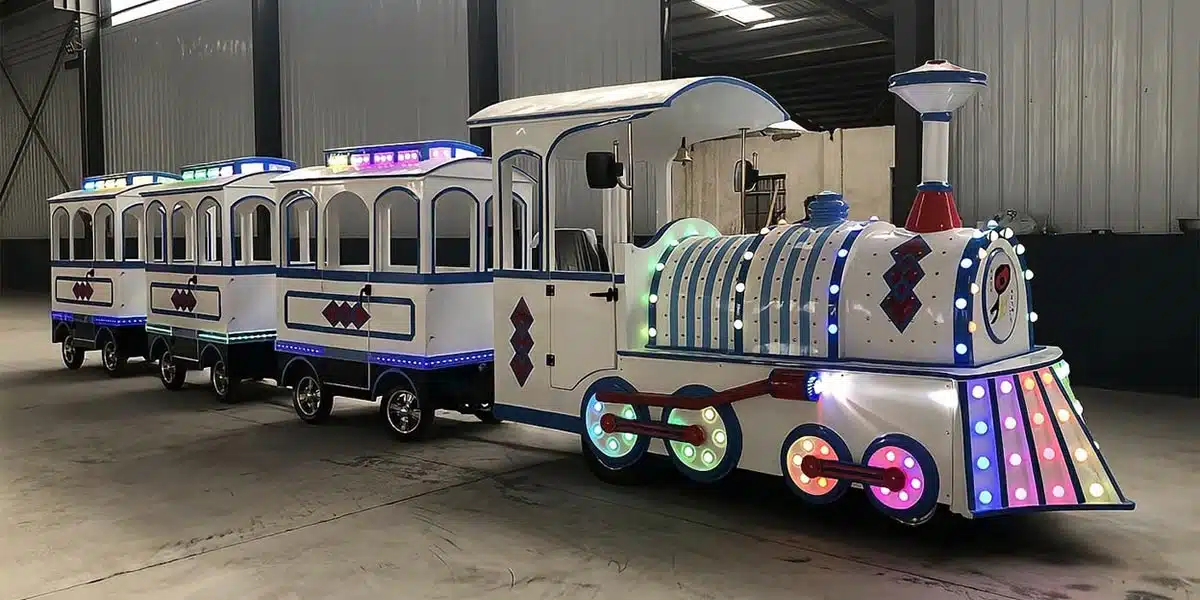
Electric trackless trains are common in parks, shopping centers, tourist attractions and amusement venues where relatively quiet operation and no tailpipe exhaust at the vehicle are useful.
Their working principle is straightforward.
The onboard battery pack stores electrical energy for the propulsion system.
When the driver operates the accelerator, the battery supplies electrical power through the vehicle’s control system.
The battery itself does not turn the wheels. It provides the energy that the motor converts into motion.
The controller manages the electrical power sent to the motor.
This allows the train to start smoothly, accelerate gradually and maintain an appropriate low operating speed.
For a passenger sightseeing train, controlled acceleration is more important than rapid acceleration because the vehicle may be carrying children, families or groups of tourists.
The electric motor converts electrical energy into mechanical rotation.
That torque then passes through the drivetrain to the drive axle and wheels.
Once the drive wheels rotate against the road surface, the locomotive moves forward and generates the tractive force needed to pull the connected carriages.
The sequence is:
Battery → Controller → Motor → Drivetrain → Drive Wheels → Locomotive Moves
This is the same basic energy-conversion principle used by other battery-electric vehicles. The U.S. Department of Energy also describes battery-electric vehicles as using energy stored in a traction battery pack to power an electric motor.
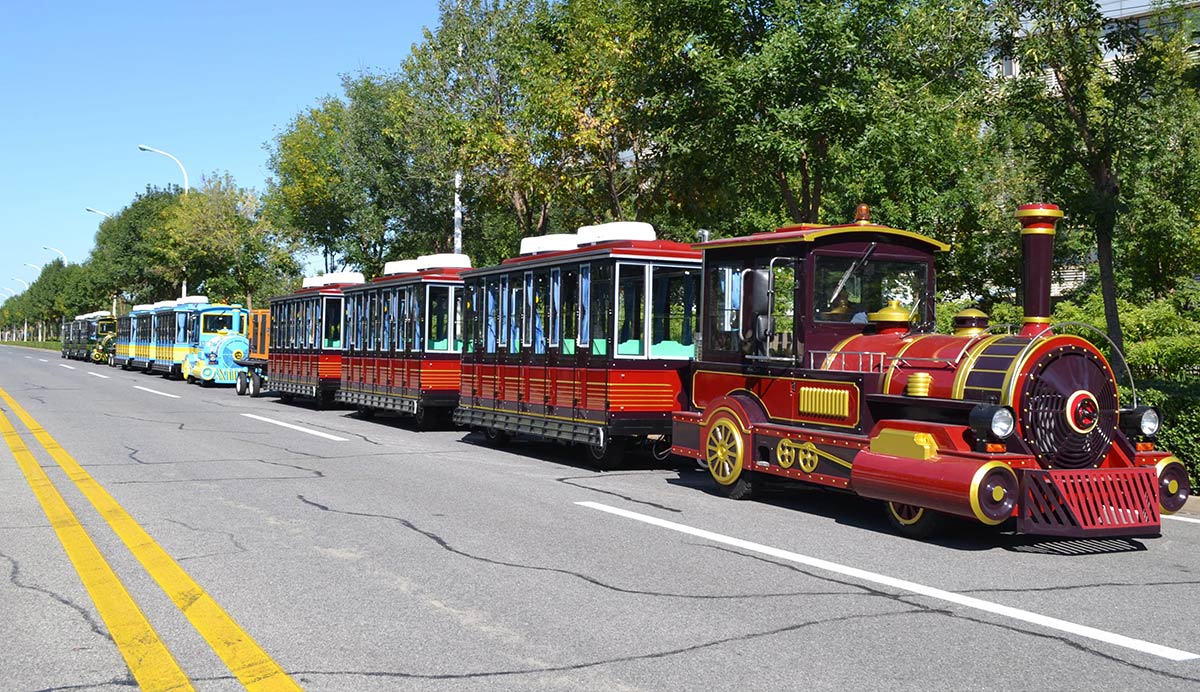
A diesel trackless train replaces the battery-and-motor propulsion system with an internal-combustion engine and drivetrain.
Its power path can be simplified as:
Diesel Engine → Transmission / Drivetrain → Drive Axle → Wheels
The engine produces mechanical power, which is transferred to the driving wheels. The locomotive then pulls the passenger carriages in the same general way as an electric model.
Diesel models can be practical for long routes or venues where convenient charging is difficult, while electric models are generally quieter and produce no exhaust directly from the vehicle during operation.
The better choice depends on daily operating hours, gradients, route length and energy infrastructure. Those trade-offs are covered separately in our Electric vs. Diesel Trackless Train comparison.
A conventional trackless train is steered by its driver.
The steering wheel changes the angle of the locomotive’s steering wheels, allowing the driver to guide the vehicle along roads, plazas or other suitable routes.
The important point is simple:
The rails guide a railway train.
The driver guides a trackless train.
Special automated vehicles may use magnetic guidance, sensors or other navigation systems, but this is not required for a conventional driver-operated tourist road train.
Turning radius depends heavily on vehicle size and carriage configuration.
Carnee’s current specifications show how much the requirement changes across the product range:
| Example Model | Power | Rated Speed | Turning Radius | Max. Slope |
|---|---|---|---|---|
| 16-seat Trackless Train | Electric | <7 km/h | >2.5 m | <3% |
| 19-seat Big Dudu Train | Electric | <7 km/h | >4.5 m | <3% |
| 28-seat Trackless Train | Electric | 20 km/h | >6 m | <3% |
| 42-seat Trackless Train | Electric | 20 km/h | >6.5 m | <3% |
| 58-seat Trackless Train | Electric | 20 km/h | >7.5 m | <8% |
| 72-seat Trackless Train | Electric | 20 km/h | >10 m | <4% |
| 72-seat Trackless Train | Diesel | 20 km/h | >10 m | <20% |
These figures show why there is no useful single answer to questions such as “How much space does a trackless train need to turn?”
A compact kiddie train may work with a relatively tight route, while a large 72-seat sightseeing train needs considerably more space. Carnee’s catalog lists turning-radius requirements ranging from more than 2.5 m on compact electric trains to more than 10 m on large 72-seat models.
Route design should therefore be based on the exact train configuration, not on a generic trackless-train figure.
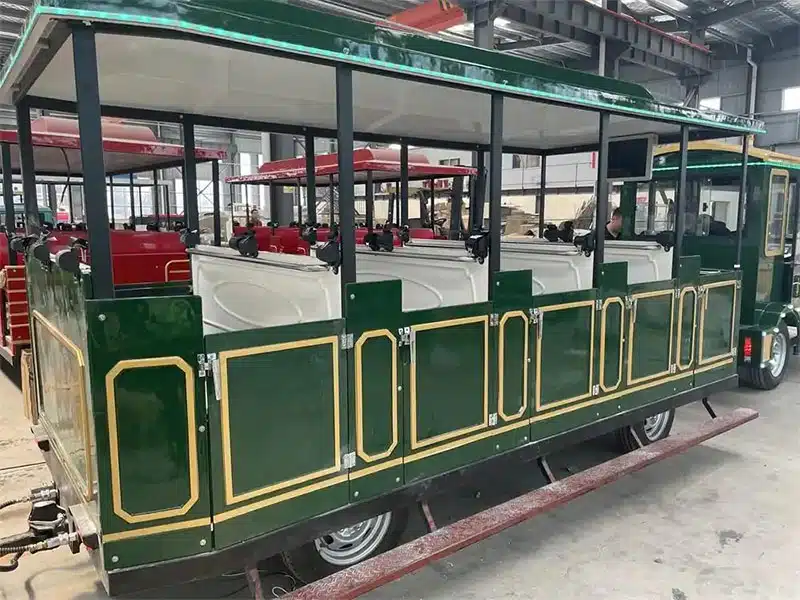
The passenger cars follow the locomotive through their drawbars, couplings and wheel or axle geometry.
The basic sequence is:
Locomotive turns → coupling changes pulling direction → first carriage follows → next carriage follows the first
Each carriage is connected mechanically to the vehicle ahead of it. When the locomotive changes direction, the pulling angle through the coupling changes as well.
The carriage wheels then allow the trailer to move into the curve.
The rear carriages do not follow exactly the same wheel path as the locomotive. Like trailers behind a road vehicle, they travel through a slightly different arc.
This is why total train length matters.
Adding more passenger cars changes:
A locomotive may be able to pass through a corner by itself while a complete multi-carriage train may require a wider route.
Manufacturer's note: Always evaluate turning clearance using the complete locomotive-and-carriage combination that will actually operate at the venue.

The driver uses the service braking system to reduce speed and stop the train during normal operation.
Depending on the model, the vehicle may also have parking and emergency braking functions.
Braking performance is affected by more than the brake system itself. Important factors include:
A fully loaded tourist train descending a slope will not stop in exactly the same way as an empty vehicle on a dry, level factory test surface.
For this reason, operators should confirm braking performance on the actual route before beginning routine passenger service.
A trackless train driver’s station operates more like a road vehicle than a railway locomotive.
Depending on the model, the controls may include:
Some configurations can also include audio, PA and decorative lighting controls.
Because the route is not mechanically fixed by rails, the driver must understand where to reduce speed, how much room the train needs at corners and how passenger loading affects vehicle behavior.
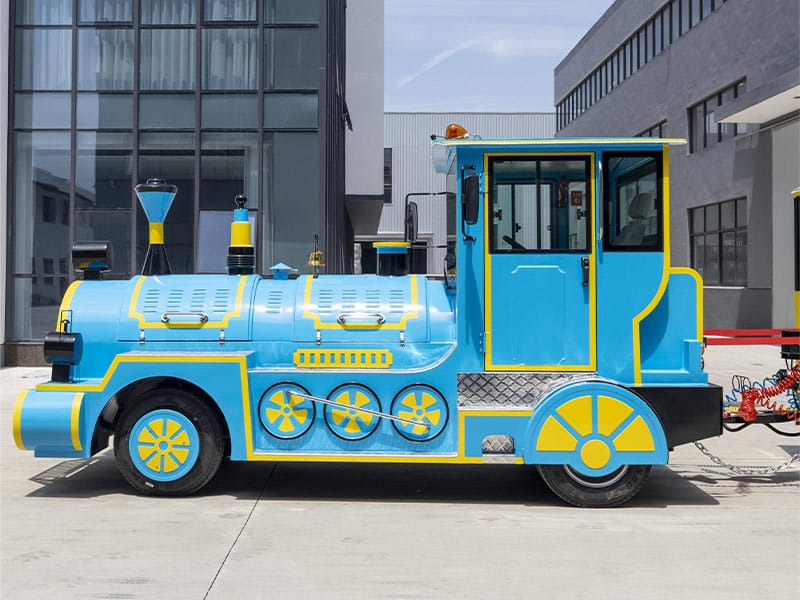
There is no single standard speed for all trackless trains.
Carnee’s smaller 11–19 seat electric models are generally rated at about 7 km/h or less, while larger 28–72 seat commercial sightseeing trains in the current catalog are rated at 20 km/h.
That difference reflects their intended use.
Compact trains are often used as:
Larger models are more likely to operate as:
Even when a train is rated for 20 km/h, normal operating speed should still be chosen according to pedestrian traffic, visibility, bends, passenger load and local rules.
Maximum rated speed is not necessarily the recommended operating speed for every part of the route.
Yes, but the maximum slope depends on the specific model and power system.
Carnee’s published trackless train specifications range from less than 3% on several compact electric models to less than 20% on the 72-seat diesel model. The 58-seat electric train, for example, is specified for slopes below 8%.
Real-world grade performance also depends on:
For a project with hills, buyers should provide the maximum route gradient rather than simply asking whether a train “can climb hills.”
Trackless trains are designed for suitable firm surfaces such as:
Some models can tolerate minor surface irregularities, but a trackless train should not automatically be treated as an all-terrain vehicle.
Deep potholes, loose ground, steep changes in level and very sharp corners can affect traction, passenger comfort and chassis loading.
The route should be evaluated when the train is considered fully loaded, not just when the locomotive is driven by itself.
If you are still planning road width, turning areas and station layout, our Trackless Train Design Guide covers those venue-planning factors in more detail.
A railway train relies on rails to support and guide its wheels.
A trackless train separates those functions:
That means there is no need for conventional railway rails and sleepers.
However, operators may still need suitable pavement, boarding areas, charging infrastructure, traffic separation or other site preparation.
So a trackless system removes the railway, not the need for good route planning.
Safety depends on the complete train design and operating environment rather than one individual device.
Relevant elements can include:
Operational safety is equally important. Drivers should follow the approved route, respect passenger capacity and reduce speed around corners, boarding zones and pedestrian areas.
International amusement-industry standards such as those developed by ASTM Committee F24 cover areas including design, manufacture, testing, operation, inspection and maintenance. Local requirements still need to be checked for the country where the train will operate.
A typical trip can be understood in a few steps.
The operator checks tires, brakes, couplings, battery or fuel level and passenger areas.
Passengers board the carriages according to the train's rated capacity.
The driver selects the direction and accelerates gradually.
The locomotive generates the pulling force through either the electric or diesel powertrain.
The couplings guide each passenger carriage behind the locomotive.
The driver adjusts speed and steering for bends, pedestrian areas and stopping points.
The train stops at the designated station and passengers disembark.
Electric trains are charged as required; diesel trains are refueled according to their operating schedule.
This operating cycle is why route design, power system and carriage quantity need to be considered together rather than as separate specifications.
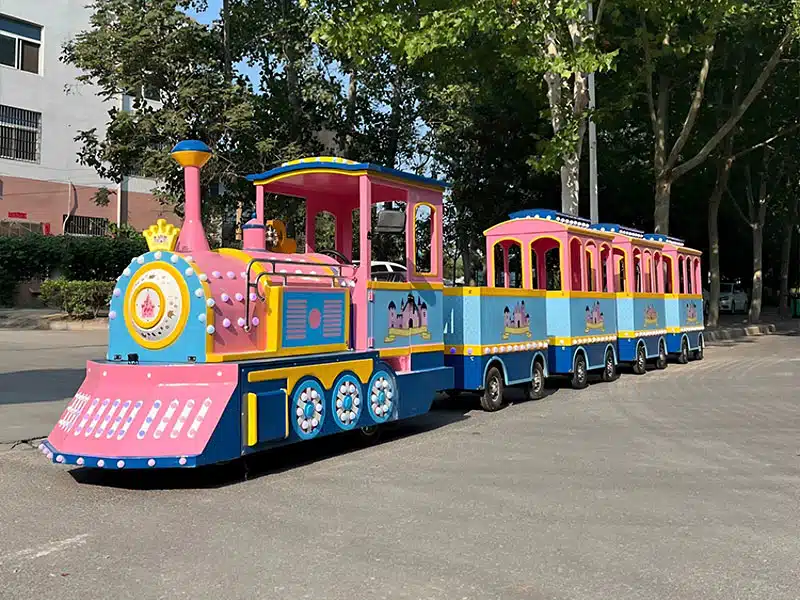
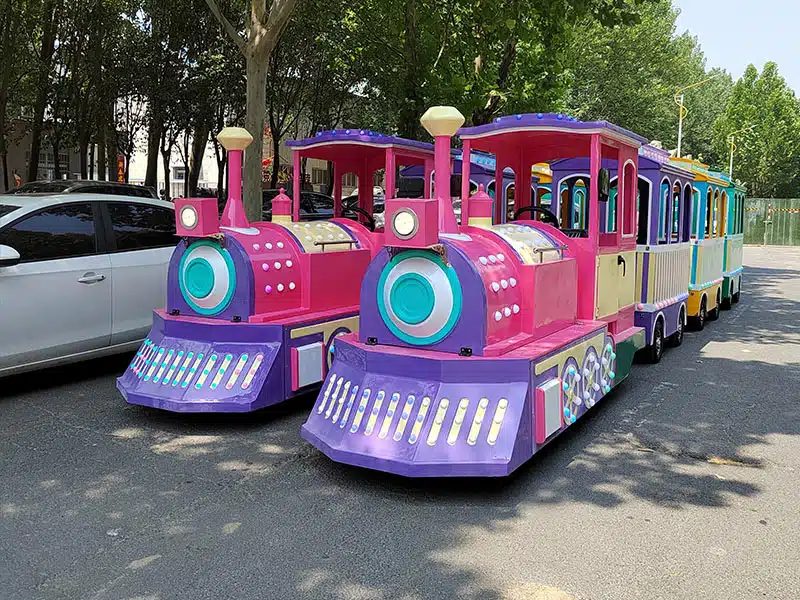
The same basic equipment is searched under different names depending on the application.
A sightseeing train or tourist road train can transport visitors between different areas of a large scenic attraction.
An amusement park train or theme park train ride can serve as both transportation and part of the visitor experience.
Compact mall trains and indoor trackless trains can operate on suitable indoor surfaces where maneuverability and relatively quiet electric power are useful.
Trackless trains are also used in zoos, resorts, city parks, farms and other visitor attractions.
The appearance and passenger capacity may change, but the fundamental principle remains the same:
a powered, steerable locomotive pulls passenger carriages on rubber tires without fixed rails.
| Feature | Trackless Train | Rail Train |
|---|---|---|
| Running surface | Road or suitable floor | Fixed railway |
| Wheels | Rubber tires | Rail wheels |
| Direction control | Driver steers | Rails determine direction |
| Route | Flexible | Fixed |
| Power | Commonly electric or diesel | Depends on system |
| Railway construction | Not required | Required |
A rail train may make sense where the railway itself is part of a permanent attraction.
A trackless train is usually more practical where the operator needs a flexible route or wants to avoid building a conventional railway.
Once you understand how the train works, the important purchasing questions become much clearer.
Before selecting a model, check:
Carnee’s current range illustrates how widely these requirements can vary. Compact trains may carry roughly 11–19 passengers, while larger commercial trackless trains are available in 28-, 42-, 58- and 72-seat configurations.
Increasing capacity usually means increasing overall train length, load and turning-space requirements as well.
If you are already comparing configurations for a tourist attraction, see our Trackless Train Buying Guide for Tourist Attractions.
No. They run on rubber tires and are steered by the driver.
Some are electric and others use diesel power. Electric models use batteries and motors; diesel models use an engine and drivetrain.
The driver steers the locomotive, while the couplings and carriage geometry allow the trailers to follow.
Each carriage is mechanically connected to the vehicle ahead and follows the direction of the pull through the coupling.
Commercial trackless trains typically operate at about 5–20 km/h, depending on the model and application. Compact electric or kiddie trains are usually around 7 km/h or less, while larger sightseeing models can reach 20 km/h.
Yes. Carnee specifications vary by model, from below 3% on some compact trains to below 20% on the 72-seat diesel model.
It depends on size. Carnee examples range from over 2.5 m for compact models to over 10 m for 72-seat trains.
Only where local vehicle, passenger-transport and traffic regulations allow it.
A flat indoor route needs a very different train from a long tourist route with several carriages and slopes.
Before choosing a model, confirm your:
route length + narrowest road width + tightest turn + maximum slope + expected passenger capacity + daily operating hours
These details determine the appropriate locomotive size, power system and carriage configuration.
If you are ready to compare commercial models, you can view Carnee’s trackless train for sale and then match the specifications to your actual route.

Whatsapp : +86 13623710276
Email : [email protected]
Address : High-tech Industrial Development Zone, Zhengzhou


WhatsApp us

