
what are you looking for?

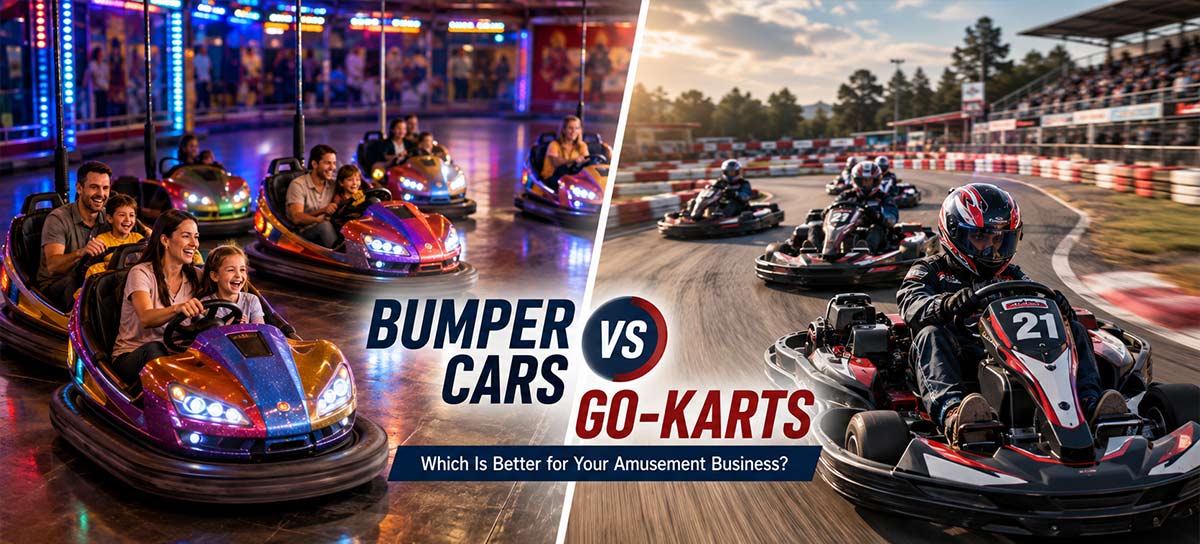
If you are comparing bumper cars vs go-karts for an amusement park, family entertainment center, resort or outdoor leisure venue, here is the practical answer:
Choose electric bumper cars if you want a family-friendly attraction that is easier to install, simpler to operate and requires less site infrastructure. Choose go-karts if you want to sell a stronger racing experience, have suitable usable space and are prepared to invest in a track and more structured daily operations.
A prospective customer recently approached Carnee with approximately 1,000 m² of outdoor space allocated to one of these projects. He liked both ideas but had never operated a karting business before.
His questions were straightforward:
Do go-karts need a track? Is 1,000 m² enough? How many vehicles should I buy? Which project costs less? Which one is easier to make profitable?
These are better questions than simply asking which ride is more fun or which vehicle has the lower purchase price.
The right decision depends on five things: your target customers, usable space, total project investment, operating capability and local demand.
| Factor | Electric Bumper Cars | Commercial Go-Karts |
|---|---|---|
| Core experience | Bumping, interaction and group fun | Driving, racing and competition |
| Main audience | Families, children and casual groups | Teens, adults and racing-oriented visitors |
| Learning curve | Very easy | Requires more driving control |
| Driving area | Open arena | Planned driving course |
| Dedicated track | No | Normally yes |
| Space use | Compact | More land-intensive |
| Power | Battery electric | Electric or gasoline |
| Controls | Steering and simple acceleration | Steering, throttle and braking |
| Intentional contact | Part of controlled play | Should be avoided |
| Infrastructure | Relatively simple | Track, barriers and support areas |
| Maintenance | Mainly vehicles and batteries | Vehicles plus track-related systems |
| Commercial model | Participation and turnover | Higher-value racing sessions |
| Easier for first-time operators | Usually yes | Requires more planning |
The rest of this guide explains why.
The biggest difference is not simply speed.
It is what the customer is paying to experience.
With bumper cars, interaction between riders is part of the product.
Customers chase each other, turn, dodge, bump friends and laugh at the reactions around them. They do not need to understand racing lines or braking points before having fun.
This makes bumper cars particularly effective in venues with:
Colorful bodies, LEDs, music and visible rider interaction also make the attraction easy to understand from outside the arena.
That is why investors often tell us:
“Bumper cars attract children very easily.”
There is a reasonable basis for that observation, but bumper cars are not exclusively children’s rides. Many commercial two-seat models are designed for family or parent-child operation.
Most ordinary commercial bumper cars operate at controlled speeds rather than racing speeds. If speed configuration is important to your project, our guide to how fast commercial bumper cars go explains typical speeds for kids, family and adult-oriented models.
Go-karts offer a different kind of enjoyment.
The attraction comes from:
The customer is paying to drive well, not to collide deliberately.
This gives karting strong appeal among:
The simplest way to distinguish the two is:
Bumper cars sell interaction. Go-karts sell driving.
So which is more fun?
For social, family and casual entertainment, bumper cars usually have the advantage.
For customers who value speed, control and competition, go-karts usually offer the stronger experience.
Before deciding how many vehicles to buy, decide who will actually pay to use them.
Bumper cars are especially suitable for:
They have a low learning barrier. Customers can understand the basic controls quickly and enjoy the attraction without developing driving skills first.
This gives bumper cars an advantage where the business depends on high participation from general visitors.
Go-karts deserve stronger consideration when your customer base includes:
Do not use fixed statements such as “go-karts are only for adults.”
Commercial karting covers children’s electric models, junior configurations, adult rental karts and higher-performance vehicles. The correct age and height requirement depends on the actual model.
Carnee supplies both commercial electric and gasoline go-karts, so the vehicle configuration can be matched to the customer group rather than forcing one type of kart into every project.
A practical first decision is:
Family-heavy traffic → evaluate bumper cars first.
Teen/adult and racing-focused traffic → evaluate go-karts first.
This is where the difference between the two businesses becomes much clearer.
First, distinguish between:
total property area
and
usable attraction area.
A venue may also need space for pedestrian circulation, other amusement rides, restaurants, landscaping, ticketing, queues and service areas.
The useful information for a manufacturer is:
For a bumper car project, 1,000 m² is more than enough to evaluate a substantial commercial attraction in most layouts.
You normally do not need to convert all 1,000 m² into a driving arena.
Our existing guide to starting a bumper car business uses these practical planning ranges:
These are planning references rather than fixed engineering rules because car size, arena shape and required clearance still matter.
For a 1,000 m² outdoor property where bumper cars occupy only part of the site, 16–18 commercial double-seat battery bumper cars would therefore be a sensible configuration to evaluate first.
A roughly 300–400 m² attraction zone can then be studied for the arena itself and surrounding operating functions, while the rest of the 1,000 m² remains available for other rides, circulation or landscape.
The supporting area should include:
The important point is:
Do not use 1,000 m² simply because you have 1,000 m². Use the amount of land the attraction actually needs.
Karting uses the same area very differently.
Professional karting manufacturer Sodikart describes around 1,000 m² as a possible starting size for a leisure karting facility and notes that facilities in the 1,000–1,500 m² range require particularly careful attention to track design and business operation. See its karting facility planning guidance.
So yes:
1,000 m² can be evaluated for commercial karting.
But it is a compact karting site.
For an initial 1,000 m² Carnee concept, we would typically begin by studying approximately:
8–10 karts operating at one time
with another:
2–4 vehicles available for charging, maintenance or rotation.
That gives an initial fleet planning range of roughly:
10–14 karts
before the final layout is approved.
This is not a universal karting standard. It is a practical starting point for discussing a compact commercial project.
The final number can only be confirmed after the route is drawn.
A 20 × 50 m rectangular plot and an irregular 1,000 m² site with several obstacles may have the same area on paper but support very different tracks.
Yes. A commercial go-kart operation normally requires a planned driving course.
However, this does not mean every amusement business needs a professional motorsport circuit.
A commercial leisure track needs to fit:
A practical go-kart track layout may need to include:
This is one of the most important differences between buying go-karts and buying bumper cars.
This is especially important for a first-time investor.
Do not decide:
“I want 15 karts.”
and then ask somebody to make the site fit them.
A better sequence is:
Site review → Track layout → Kart type → Operating quantity → Reserve quantity → Final quotation
Send us:
Carnee can then help evaluate the site and develop a track concept before the final kart configuration is confirmed.
If you are also deciding between different power systems, our electric vs gas go-karts comparison explains how charging, refueling, maintenance and operating environment affect that decision.
For battery bumper cars, the answer is much simpler:
No dedicated racing track or conductive floor is required.
They can normally operate on an appropriate flat, hard surface such as suitable concrete or another properly prepared hard floor.
You still need to plan:
However, not every bumper car system works the same way.
Battery-powered models carry their energy onboard.
They do not require a conductive floor or overhead grid, making them attractive for outdoor venues, leased properties, temporary installations and projects where the operator wants layout flexibility.
Ground-grid cars receive continuous electricity through a specially built conductive floor.
They can suit permanent, high-frequency venues but require more infrastructure at the beginning.
Ceiling-grid systems rely on overhead electrical infrastructure and are generally associated with permanent installations.
If you are unsure which system fits your business, our detailed comparison of battery vs ground-grid bumper cars explains differences in installation, operation and total cost of ownership.
For the first-time outdoor 1,000 m² project discussed here, battery bumper cars would normally be the first configuration we evaluate.
The direct answer is:
A commercial bumper car project normally has a lower entry barrier than a comparable commercial karting project because karting requires a driving track and additional supporting infrastructure.
But do not compare only the price of one vehicle.
The correct comparison is:
complete operating project vs complete operating project.
Carnee’s current battery bumper car range is approximately:
US$800–1,050 per car
depending on dimensions, materials, seating and customization.
Using that published price as a vehicle-only reference:
16 cars
approximately US$12,800–16,800
18 cars
approximately US$14,400–18,900
The project may then require additional spending on:
For buyers who want a fuller budget reference, our commercial bumper car system cost guide breaks down battery, ground-grid and ceiling-grid project costs using a 10-car commercial setup.
Go-kart pricing has a wider range because a children’s electric kart, adult rental kart and high-performance kart are not equivalent products.
The vehicle fleet is also only one part of the project.
A karting budget may include:
This is why a quotation saying:
“One kart costs US$X”
does not tell you the real cost of opening a karting business.
For a 1,000 m² buyer, we would first determine the track and fleet configuration, then prepare a complete equipment quotation.
If your budget is limited and you want fewer construction variables:
battery bumper cars are normally easier to budget.
If you are willing to invest more to create a dedicated racing experience:
go-karts may justify the higher project complexity.
This matters long after the equipment arrives.
Routine work mainly involves checking:
There is no karting track to inspect every operating day.
For a first-time amusement investor with limited technical staff, this is an important advantage.
Karting adds more driving-related wear points, including:
Operators must also monitor:
Daily operation normally requires more customer management as well:
This does not mean go-karts are unreliable.
It means:
Karting requires a more structured maintenance and operating system.
It is inaccurate to say:
“Bumper cars are safe and go-karts are dangerous.”
It is equally inaccurate to say bumper cars require lower safety standards.
The two attractions manage different types of risk.
Bumper cars are designed around controlled, relatively low-speed vehicle interaction.
Safety therefore involves:
You can find a more detailed checklist in our bumper car safety guide for parks and FECs.
Go-karts are designed for directional driving rather than intentional collisions.
Safety management therefore places greater emphasis on:
IAAPA’s ride safety regulation resources also point operators toward recognized amusement-industry standards covering design, manufacture, operation, maintenance and inspection.
The correct conclusion is:
Bumper cars and go-karts need different safety strategies because customers use the vehicles differently.
Specific operating requirements should always be based on the equipment supplied and applicable local regulations.
This is where investors hear completely opposite opinions.
One person says:
“Bumper cars attract children, cost less and make money quickly.”
Another says:
“Go-karts have higher ticket prices, so karting is more profitable.”
There is a reason both opinions exist.
Bumper cars combine several commercial advantages:
They can also work as a visual traffic attraction.
People passing the arena can immediately see movement, lights, interaction and other customers having fun. That can help convert existing foot traffic into paid rides.
This business model is particularly attractive in:
If bumper-car profitability is a major part of your decision, our dedicated bumper car business profit and ROI guide goes deeper into ticket revenue, operating costs and payback calculations.
Karting has a different advantage:
it can support a more premium experience.
Operators can monetize:
Therefore, a successful karting venue can earn more from each customer than a simple amusement ride.
But that does not automatically mean it produces more net profit.
Karting also carries higher track, staffing and maintenance requirements.
Consider two hypothetical projects.
These numbers are for illustrating the business model, not promising revenue.
Assume:
Gross revenue:
8 × US$4 × 8 = US$256 per hour
Assume:
Gross revenue:
4 × US$10 × 4 = US$160 per hour
At US$15 per driver:
4 × US$15 × 4 = US$240 per hour
If all eight kart positions are filled:
8 × US$15 × 4 = US$480 per hour
This explains the conflicting opinions.
Bumper cars can win through participation and turnover.
Go-karts can win through higher ticket value and strong utilization.
The critical question is whether your local market can actually fill the sessions.
There is no responsible way to promise every investor:
“You will recover the investment in six months.”
without knowing the venue economics.
Use your actual business numbers.
A basic calculation is:
Monthly Revenue = Average Ticket Price × Average Paying Riders per Session × Sessions per Day × Operating Days per Month
Then calculate:
Monthly Operating Profit = Revenue − Rent − Labor − Electricity/Fuel − Maintenance − Marketing − Other Operating Costs
Finally:
Simple Payback Period = Total Project Investment ÷ Monthly Operating Profit
For example:
If your completed project costs:
US$40,000
and generates:
US$5,000 monthly operating profit
the simple payback is:
8 months
If the same project earns only:
US$2,000 per month
the payback becomes:
20 months
That difference is why location and real customer demand matter more than an online claim that one ride is always more profitable.
Here is the practical decision.
For a 1,000 m² property, a practical first concept is:
16–18 commercial double-seat battery bumper cars
using only the area actually required for the arena and supporting functions.
You can view Carnee’s current commercial bumper cars for sale when comparing vehicle styles and configurations.
For a compact 1,000 m² karting project, a useful preliminary planning range is:
8–10 karts operating at one time + 2–4 rotation/backup vehicles
with the final quantity confirmed only after the layout is completed.
For a full-size commercial concept:
we would generally not recommend forcing both a substantial bumper-car arena and a substantial go-kart track into the same 1,000 m².
The karting experience usually suffers first because every square meter removed from the route affects track layout.
A small children’s kart concept combined with a compact bumper-car attraction can be evaluated, but that is a different business model.
If you want both attractions to feel complete, more usable land is preferable to creating two undersized experiences.
The two attractions are not always direct competitors.
They can serve different customers within the same amusement park.
Carnee has supplied an outdoor amusement project with:
in the same project.
You can see the actual go-kart and battery bumper car project here.
The lesson is not that every park should buy both.
It is that:
Bumper cars can serve family and social entertainment while go-karts serve racing-oriented visitors.
For a larger park with enough land and budget, the better question may therefore be:
How should we position both attractions for different customer groups?
The 1,000 m² customer mentioned at the beginning had no previous karting experience.
That is not unusual.
You should not need to know the perfect track shape, number of karts or charging layout before contacting a manufacturer.
For a new Carnee project, the practical process is:
Send:
Identify whether the business mainly serves:
Compare:
For karting:
design the track before finalizing the fleet.
For bumper cars:
determine arena size, vehicle quantity, charging and customer flow.
Only after the project requirements are clear should the final:
be confirmed.
The project can then move into:
The principle is simple:
The site and business model should determine the equipment configuration—not the other way around.
For a useful project recommendation, send the manufacturer:
| Information | What to Provide |
| Project location | Country and city |
| Venue type | Amusement park, FEC, resort, mall, tourist attraction, etc. |
| Usable site | Exact length × width |
| Layout | CAD, plan, screenshot or hand sketch |
| Environment | Indoor or outdoor |
| Surface | Concrete, asphalt or unfinished ground |
| Target customers | Children, families, teens or adults |
| Current preference | Bumper cars, go-karts or undecided |
| Power preference | Battery, electric, gasoline or unsure |
| Expected capacity | If known |
| Opening schedule | Target opening date |
If you have not decided which attraction to buy, do not worry.
Instead of asking:
“How much are 10 go-karts?”
send us the site and ask:
“This is my 1,000 m² area. Which project and configuration would you recommend?”
That gives us enough information to provide a project solution rather than simply sending a product price list.
Bumper cars focus on social interaction and controlled contact inside an open arena. Go-karts focus on acceleration, braking, cornering and racing along a planned driving course. That difference affects the customer group, infrastructure, maintenance and revenue model.
Yes. Commercial go-karts normally require a planned driving route with appropriate barriers and supporting areas. It does not need to be a professional motorsport circuit, but the track should be designed before the final kart quantity is determined.
Yes, a 1,000 m² commercial karting concept can be evaluated, but it is a compact site. Track shape, kart dimensions, supporting areas and desired driving experience are particularly important. A practical initial concept may evaluate approximately 8–10 operating karts before the final plan is confirmed.
For most first-time projects, battery bumper cars are cheaper and simpler to start because there is no dedicated karting track to build. Carnee’s current battery bumper car reference price is approximately US$800–1,050 per vehicle, before shipping and local site work.
No. Many commercial bumper cars are designed for families, adults or parent-child use. The rider requirements should be based on the specific model rather than a single age assumption.
Yes. Carnee can review your site dimensions and drawings, assist with the initial track layout, recommend kart type and quantity, manufacture the equipment and support the project through delivery and operation.
There is no universal winner in the bumper cars vs go-karts comparison, but there are clear situations where one makes more sense.
If you have around 1,000 m², mainly serve families, are new to the amusement business and want lower project complexity:
Battery bumper cars are usually the more practical first choice.
If your market has strong teen and adult racing demand, customers will pay more for driving sessions and you are prepared to build and operate a proper course:
Go-karts can become the stronger premium attraction.
For larger projects, the two attractions can complement each other instead of competing.
Before ordering, answer five questions:
Who will pay to ride it?
How much usable space do I actually have?
What will the complete project cost—not only the vehicles?
Can my team operate and maintain it properly?
How many paying customers can the local market realistically support?
Once those questions are answered, choosing between bumper cars and go-karts becomes much easier.
Still deciding? Send Carnee Rides your usable site dimensions, drawing or photos. We can review the layout first and recommend the attraction type, vehicle quantity and configuration before you commit your project budget.

Tags :
Whatsapp : +86 13623710276
Email : [email protected]
Address : High-tech Industrial Development Zone, Zhengzhou


WhatsApp us

